By DoraPony editorial team

For baby brands, safety is not a feature added at the end of development. It is a system that starts with the product brief and continues through material approval, engineering, tooling, production, inspection, and shipment.
Baby bottles, nipples, pacifiers, teethers, feeding sets, training cups, and tableware may contact food, milk, or a child's mouth. A competitive quotation alone is therefore not enough. Brands also need a manufacturer that can explain how materials are controlled, how designs are reviewed before tooling, how production lots are traced, and how quality requirements are verified.
DoraPony supports OEM, ODM, and private-label baby feeding projects in China. This guide explains the manufacturing questions brands, importers, and product developers should resolve before committing to molds or mass production.
Important: Product requirements vary by design, material, age grade, intended use, and destination market. Manufacturing and documentation support do not replace the brand owner's, importer’s, or responsible party's obligation to confirm the laws and standards that apply to a specific product.
What matters more than “made in China”
China offers a deep manufacturing ecosystem for plastic molding, liquid silicone rubber, tooling, decoration, assembly, packaging, and laboratory coordination. The value of that ecosystem depends on how well a supplier manages it.
A baby bottle may combine a PPSU, polypropylene, or copolyester body with silicone components, seals, printed decoration, and custom packaging. A feeding set may combine silicone, plastic, and stainless-steel parts. Each material and process introduces its own tolerances, supplier controls, and inspection needs.
Instead of asking only where a product is made, ask:
Can the manufacturer control the engineering, materials, tooling, and quality records needed to make this product consistently?
That question is more useful because it focuses the supplier discussion on evidence rather than sales claims.
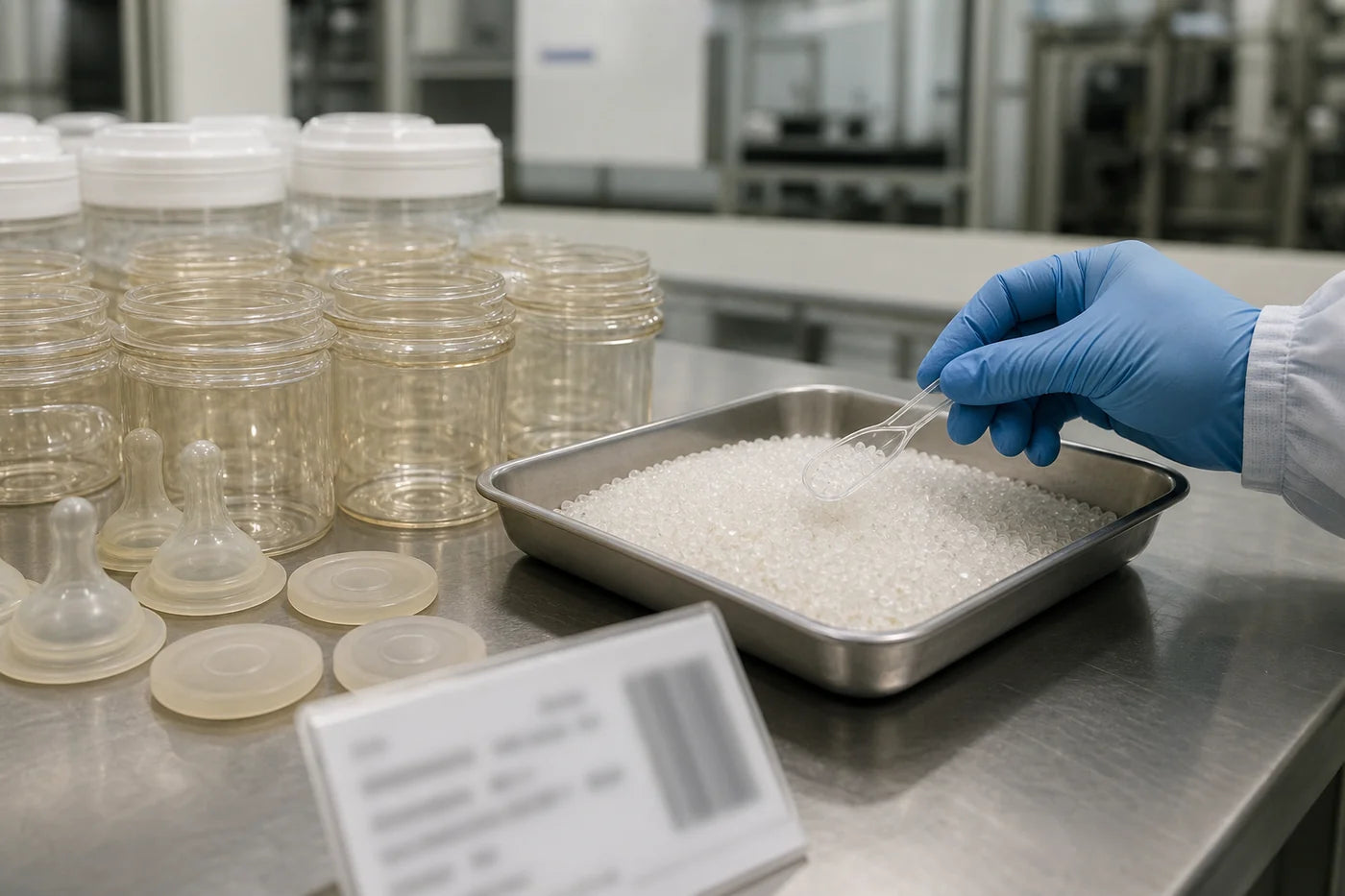
Material safety starts with an approved specification
Common materials in baby feeding products include:
- Platinum-cured silicone or liquid silicone rubber
- PPSU
- Polypropylene (PP)
- Copolyesters such as Tritan™
- Glass
- Stainless steel
The material name is only the starting point. Grade, supplier, color formulation, hardness, processing conditions, and intended use can all affect performance.
A practical material-control plan may include:
- An approved material specification and qualified supplier
- Supplier documentation appropriate to the project
- Incoming material inspection
- Batch or lot identification
- Color, hardness, and appearance limits
- Defined storage and handling conditions
- Production records that connect raw-material lots to finished-product lots
Traceability matters because it helps a brand define the scope of an investigation if a problem occurs. The team should be able to identify which material lot was used, when the product was made, and which finished lots may be affected.
Silicone is a system, not a single specification
Silicone is widely used for nipples, pacifiers, teethers, spoons, bowls, plates, valves, and seals. However, two parts described simply as “silicone” may behave very differently.
Important variables can include:
- Material formulation and curing system
- Shore hardness
- Wall thickness and geometry
- Mold design and venting
- Cure and post-cure conditions
- Surface finish and color formulation
A small change in hardness or wall thickness can change the feel of a nipple, the closing force of a valve, or the durability of a teether. Material selection should therefore be reviewed together with product geometry, mold design, and expected use—not treated as an isolated purchasing choice.
Define market requirements before tooling
The manufacturing location does not change the requirements of the market where a product will be sold. Depending on the product and destination, the compliance plan may address:
- Food-contact material requirements
- Lead and phthalate restrictions
- Mechanical and physical safety
- Small-parts considerations
- Product labeling and warnings
- Traceability and recordkeeping
- Product-specific test methods or standards
For the United States, relevant obligations may involve CPSC children’s product requirements, FDA food-contact requirements, and product-specific standards. The European Union applies its own food-contact-material framework, while the United Kingdom and other markets have separate requirements and responsible-party obligations.
Brands should confirm the applicable requirements with qualified compliance professionals and testing laboratories. An OEM/ODM partner can support that process with production samples, material information, manufacturing records, and traceability documents agreed for the project.
The best time to define this plan is before the mold is cut. Late compliance changes can require new materials, structural revisions, label changes, or even replacement tooling.
Use DFM to find risks before the mold is built
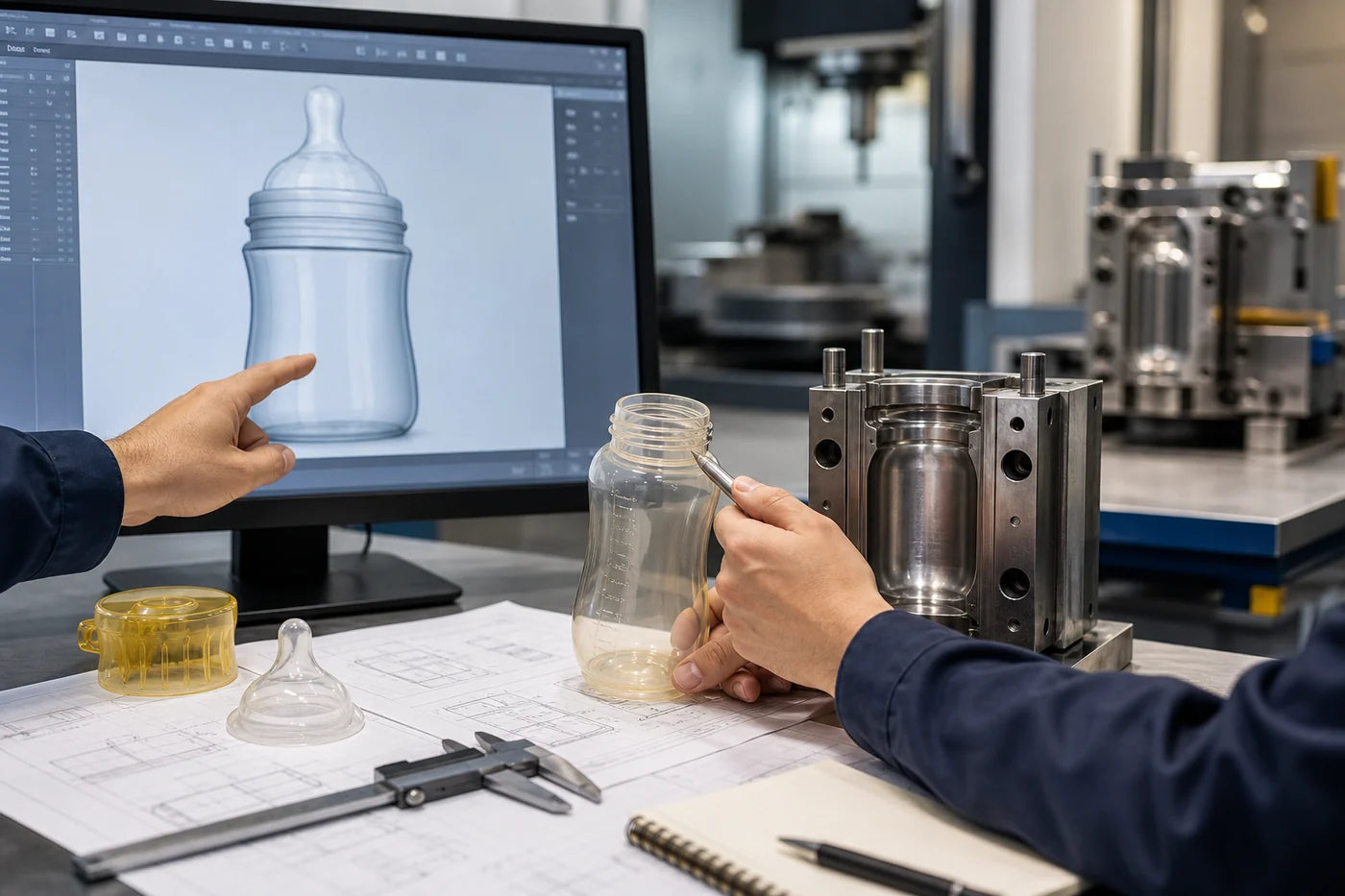
A polished rendering is not automatically a production-ready design. Design for manufacturing (DFM) turns the concept into a set of parts that can be molded, assembled, and inspected consistently.
A DFM review for baby feeding products may examine:
- Wall thickness and transitions
- Draft angles and undercuts
- Parting lines and gate locations
- Sealing surfaces
- Tolerances and material shrinkage
- Assembly sequence
- Mold release
- Strength and drop-risk areas
- Cleanability and hard-to-reach geometry
Rigid plastic parts can deform, sink, or vary dimensionally when wall design and process windows are not well controlled. Silicone parts can cure or feel inconsistently when thickness varies unnecessarily. Bottles, straw cups, and food containers also require careful tolerance planning because small dimensional differences can lead to leakage or difficult assembly.
A practical route from idea to mass production
Projects arrive at different stages. A brand may provide production CAD, an industrial design, a sketch, a reference sample, or an early concept. A typical development route can include:
- Product and market requirement review
- Material recommendation and specification
- Engineering and DFM review
- 3D design optimization
- Prototype development
- Prototype evaluation
- Mold design and tooling
- T1 sample review
- Testing and revisions
- Pilot production
- Mass production and ongoing quality control
Each approval gate should define what is being approved, who owns the decision, and which records will be retained. The goal is to discover design and manufacturing risks while changes are still relatively fast and inexpensive.
For a closer look at this workflow, visit DoraPony OEM/ODM services and the factory overview.
What determines tooling and unit cost?
There is no universal mold price or unit price for a custom baby product. Cost depends on the product, material, tool strategy, quality plan, packaging, and expected volume.
Tooling cost may be influenced by:
- Product size and number of components
- Mold structure and number of cavities
- Tolerance and surface requirements
- Tool steel and expected service life
- Automation and inspection requirements
- Planned production volume
Material selection also affects both raw-material cost and processing. Higher-volume projects may justify multi-cavity tooling or automation, while lower-volume projects may need a different balance between initial investment and unit cost.
A useful quotation should therefore connect tooling assumptions, order quantity, specification, quality plan, packaging, and unit price. Without those assumptions, two prices may not describe the same deliverable.
Quality control belongs throughout production
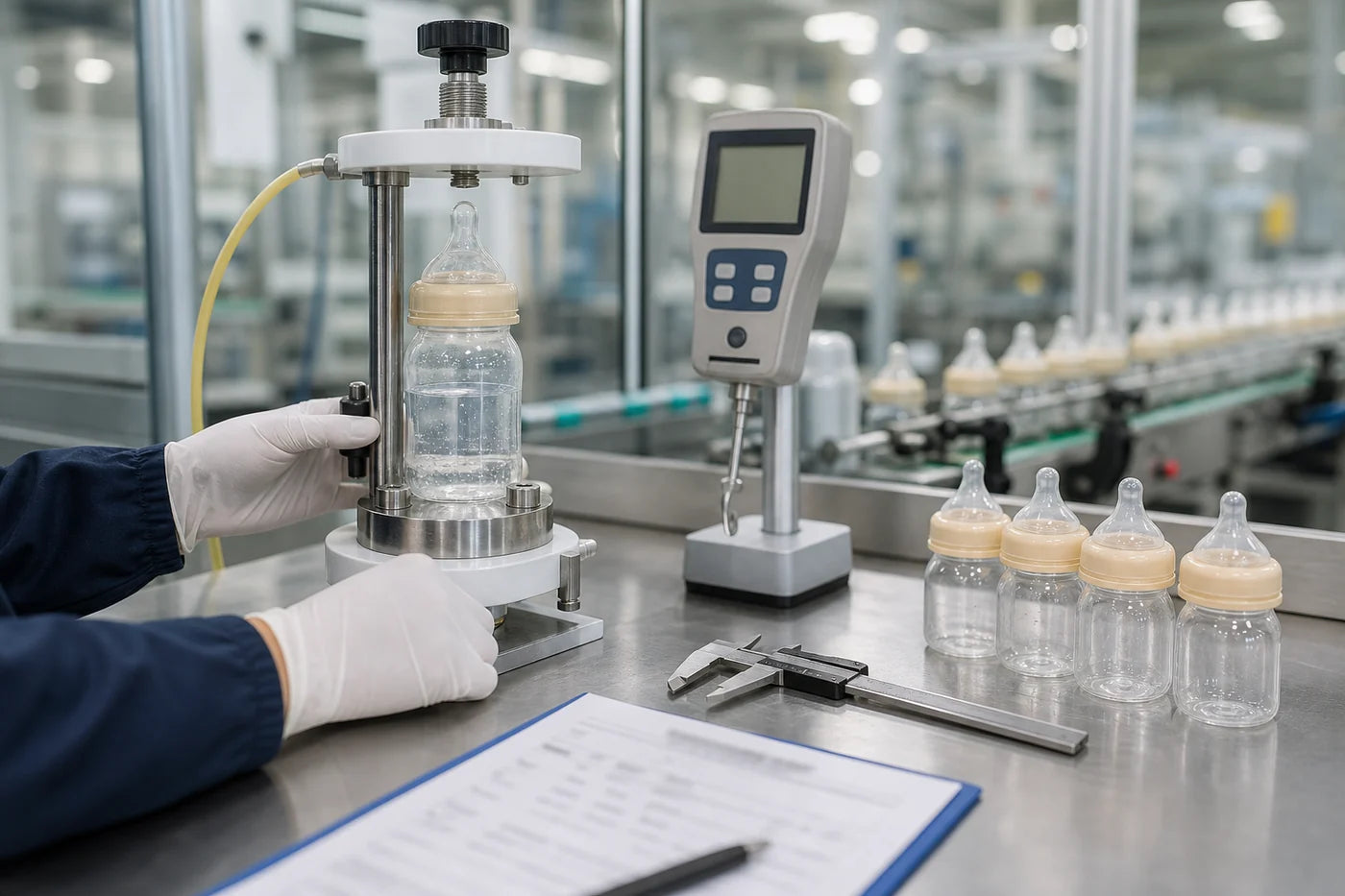
Final inspection cannot correct a weak process. Quality needs to be planned from incoming materials through molding, assembly, functional testing, packing, and release.
Depending on the product, checks may include:
- Incoming material inspection
- First-article and in-process dimensional inspection
- Leak, pull, torque, valve, or assembly testing
- Drop or durability testing where appropriate
- Appearance, color, weight, and printing checks
- Packaging and quantity verification
- Final inspection against an agreed sampling plan or AQL criteria
The exact test method and acceptance limits should be documented for the product. Reference samples, drawings, specifications, and inspection records should agree with one another.
Why manufacturing experience matters
Manufacturing experience becomes most valuable when a product does not behave as expected.
A bottle may leak. A silicone component may feel too soft. A lid may become difficult to assemble. A rigid part may warp. Color may drift between lots. Printed decoration may not withstand the intended cleaning cycle.
These problems are rarely solved by one department. They require engineers, mold makers, production teams, material suppliers, and quality staff to trace the cause and verify the correction.
DoraPony draws on three decades of manufacturing experience when reviewing these details. The practical value is not the number alone; it is the ability to recognize risk patterns early, communicate trade-offs clearly, and build checkpoints into the production plan.
OEM, ODM, or private label?
The right route depends on the brand's design ownership, launch timing, budget, order volume, and required differentiation.
OEM manufacturing
For a customer with a completed design, an OEM program can cover engineering review, tooling, molding, assembly, quality control, and packaging according to the approved specification.
ODM development
For a new product concept, an ODM program can start earlier with material recommendations, engineering development, prototypes, DFM, tooling, testing support, and mass-production preparation.
Private label
For a faster route to market, an existing product platform may support selected customization such as colors, decoration, packaging, product combinations, or accessories. Available options and ownership should be defined before sampling.
Questions to ask a baby product manufacturer
Use these questions to compare suppliers before choosing on price alone:
- Which baby-product materials and molding processes do you handle in-house?
- How are raw-material suppliers, specifications, and lots controlled?
- What material and production documentation can be provided for this project?
- How are finished lots connected to incoming material lots?
- Who performs DFM, and what is included in the review?
- How are mold ownership, maintenance, and design confidentiality handled?
- Which inspections and functional tests are performed during production?
- How are failed inspections investigated and corrected?
- How do you coordinate samples for third-party testing?
- Which packaging and decoration processes are supported?
- Which assumptions determine the quoted mold price, MOQ, and unit price?
Reliable suppliers should be able to answer with a clear process and project-specific evidence—not only a generic capability list.
Plan the next step before tooling
The best time to involve a manufacturing partner is before the design is locked. Early review can identify material, sealing, tooling, assembly, testing, and cost risks while the project still has room to change.
Send DoraPony your concept, drawing, 3D file, target market, expected volume, and launch requirements. Our team can review the manufacturing route and help define the questions that should be resolved before tooling.
Start an OEM/ODM baby product project with DoraPony
You can also review our quality approach before your first supplier discussion.
